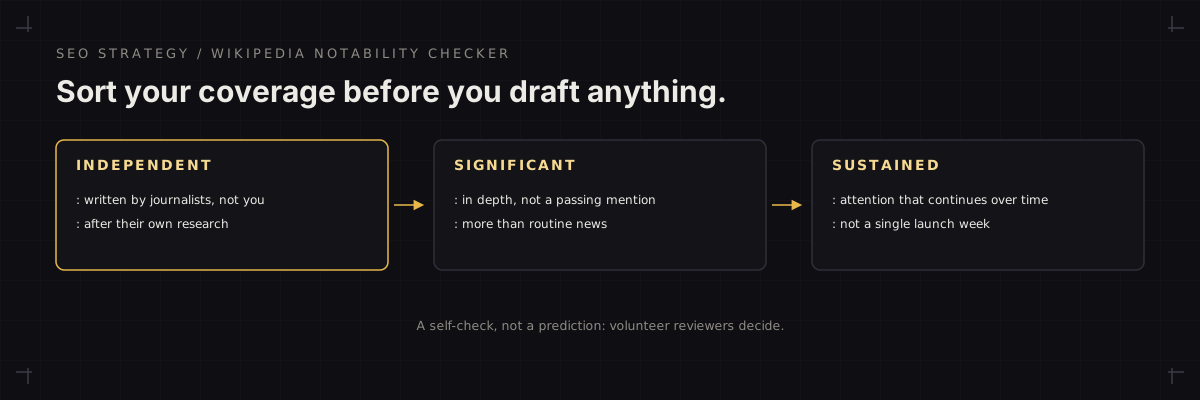
Short answer: Wikipedia does not publish a pass mark, but it does say what it looks for: significant coverage of the subject in reliable sources that are independent of it. This checker turns that into a quick self-test. Sort the coverage you have, set aside what does not count, and see whether a draft is worth attempting now or whether you need more independent coverage first. It is a self-check, not a prediction, because volunteer editors make the final call.
People usually ask "am I notable enough for Wikipedia?" after collecting a pile of press. The honest answer depends on the quality of that press, not its volume: ten press releases are worth less than two serious pieces by journalists who researched the story themselves. Answer the questions below and the tool applies the same distinctions a reviewer would.
Free Tool
Pieces written mainly about the subject by journalists at national newspapers, broadcasters or major magazines, after their own research.
Independent pieces in trade publications with real editorial standards, or substantial regional press.
Count only items you already included above. These are discounted, not ignored.
Press releases, sponsored or contributor posts, pay-to-enter lists, and your own site or social channels. These never count.
How the check works
- Strong. Independent, in-depth pieces from national or major outlets, written by journalists after their own research.
- Supporting. Independent coverage in trade publications with real editorial standards, or substantial regional press. Useful, but usually weaker on its own.
- Discounted. For companies, routine coverage such as funding rounds, launches, hires and partnerships. For people, brief mentions and interviews where the person only speaks. These come out of the count, strong items first.
- Never counted. Press releases, sponsored and contributor posts, pay-to-enter lists, and your own site and social channels.
- Adjustments. If the pieces only mention the subject in passing, nothing counts. If only some go into depth, the count is halved. If coverage is one short burst or a single event, the result is capped at Borderline.
- Levels. Promising needs three strong pieces, or two strong plus two supporting. Borderline is two strong pieces, or one strong plus enough supporting to make three. Anything less is Not yet.
These thresholds are a rule of thumb for this tool, not Wikipedia policy. The policy asks for significant coverage in multiple reliable, independent sources and leaves the weighing to reviewers.
What counts as independent
| Source | How it is usually treated |
|---|---|
| A journalist's own substantive piece at a national outlet | Counts, strongly |
| Trade press with editorial standards | Counts, often moderately |
| Regional business press | Supporting, weaker alone |
| Press release or wire distribution | Does not count |
| Sponsored, contributor or pay-to-enter content | Does not count |
| An interview where the subject does the talking | Limited, since the subject's own words are not independent |
| Your website, social profiles, company registry entries | Do not count toward notability |
Why companies and people are scored slightly differently
Companies and organizations fall under NCORP, which is explicit that routine coverage such as announcements, funding and product launches does not establish notability on its own. People fall under the biography guideline, where coverage tied to a single event is treated with caution. The tool asks a slightly different question about weak items for each, but the same idea sits behind both: attention that is independent, substantial and sustained.
What to do with your result
- Not yet. Do not submit a draft. A decline makes the next attempt harder, so earn independent coverage first and re-run the check as it arrives. The guides on what getting featured on Wikipedia actually means and how long approval takes set realistic expectations.
- Borderline. Test your best two or three sources again for independence and depth, and consider waiting for one more strong piece. If a draft has already been declined, read what to do next.
- Promising. A draft is worth attempting through Articles for Creation. Disclose your connection first, write neutrally from the sources, and expect reviewers to ask for changes. The paid editing disclosure rules and the guide to writing your own page cover the process.
Country matters for which outlets reviewers recognize, so see the notes for US businesses and UK businesses, or the India service page.
A note on conflicts of interest
If you are connected to the subject, Wikipedia asks you to disclose it, and paid contributors must disclose under the Wikimedia Terms of Use. That applies to anyone writing for the subject, including me. I offer Wikipedia page creation and notability consulting, and I will say plainly when the coverage is not there yet, because a draft that fails helps nobody. For the underlying rules, read the notability guidelines explained and the NCORP guide for startups.
FAQ
Can a tool tell me whether my Wikipedia page will be accepted?
No. A checker can sort your sources the way Wikipedia's guidelines describe and flag the usual weaknesses, but acceptance is decided by volunteer editors who read the actual sources and the draft. Treat a good result as a reason to draft carefully, not as a promise.
- A checker can sort sources and flag weaknesses.
- Volunteer editors make the real decision, so nothing is guaranteed.
How many sources do I need for Wikipedia notability?
There is no fixed number in the guidelines. They ask for significant coverage in reliable sources that are independent of the subject, and reviewers weigh quality over count. Several substantial independent pieces are a common benchmark, while a long list of releases, sponsored posts and passing mentions adds almost nothing.
- The guidelines set no fixed count, only quality tests.
- Several in-depth independent pieces beat many weak ones.