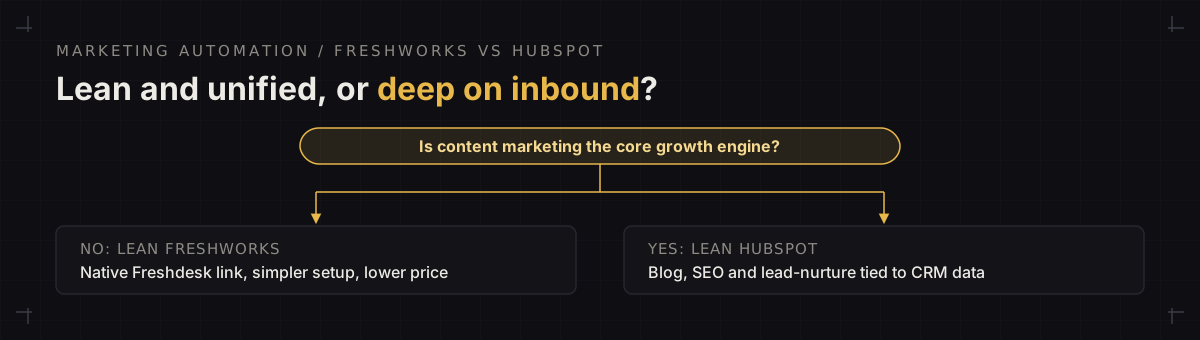
Short answer: Freshworks (Freshsales CRM plus Freshmarketer) is simpler to set up and generally more affordable than HubSpot, with a genuine advantage for teams already using Freshdesk for customer support, while HubSpot's marketing suite goes deeper on content marketing, SEO tooling, and inbound lead generation. Teams prioritizing a lean, unified sales-and-support stack should lean Freshworks; teams building a content-driven inbound strategy should lean HubSpot.
1. Where Freshworks genuinely wins
Freshsales is generally regarded as simpler to onboard than HubSpot's CRM, with a cleaner, less feature-dense interface that suits teams who want a working pipeline quickly without a long setup process. The bigger structural advantage is the shared ecosystem with Freshdesk: a team running both gets a genuinely unified customer view across sales and support, something that requires third-party integration work to replicate with HubSpot and a separate support tool.
2. Where HubSpot genuinely wins
HubSpot's marketing suite was built specifically around inbound content strategy: blog and SEO tooling, landing pages, and lead-nurture workflows tied tightly to CRM data. A team whose growth strategy leans heavily on content marketing and organic lead generation will generally find HubSpot's tools more purpose-built for that specific motion than Freshmarketer's more general-purpose automation features.
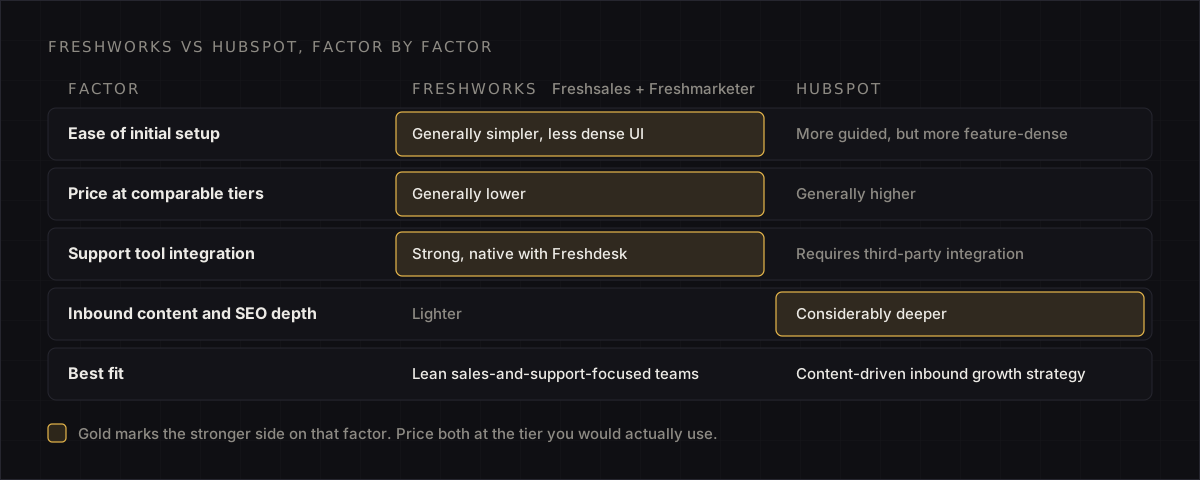
| Factor | Freshworks (Freshsales/Freshmarketer) | HubSpot |
|---|---|---|
| Ease of initial setup | Generally simpler, less dense UI | More guided, but more feature-dense |
| Price at comparable tiers | Generally lower | Generally higher |
| Customer support tool integration | Strong, native with Freshdesk | Requires third-party integration |
| Inbound content/SEO tooling depth | Lighter | Considerably deeper |
| Best fit | Lean sales-and-support-focused teams | Content-driven inbound growth strategy |
3. The question that actually decides it
If customer support and sales need to share data closely, and the growth strategy isn't primarily content-and-SEO-driven, Freshworks' unified ecosystem and lower cost usually win out. If inbound content marketing is the core growth engine, HubSpot's deeper, more purpose-built tooling for that specific motion tends to justify its higher price.
4. What to check before deciding
- Whether customer support and sales need a unified view of the customer relationship, favoring Freshworks if so.
- How central content marketing and SEO are to the actual growth plan, favoring HubSpot if that's the primary channel.
- The realistic price difference at the seat count and feature tier actually needed, not just entry-level pricing.
For the equally India-relevant CRM comparison this pairs with, see my Zoho CRM vs. HubSpot guide, and for how HubSpot compares to another simple, sales-focused CRM, see Pipedrive vs. HubSpot. My marketing automation service helps set up whichever platform actually matches your sales-and-support workflow.
5. Freshworks vs HubSpot: a quick decision rule
- Lean Freshworks if sales and support need one view of the customer, you want faster onboarding, and price matters at your seat count.
- Lean HubSpot if content marketing and SEO drive growth, and you want lead nurture tied tightly to CRM data.
- If you are split, price both at the tier you would actually use before deciding.
FAQ
Is Freshworks a good HubSpot alternative for a small team?
Yes, for a small team that wants a straightforward CRM and basic marketing automation without a steep learning curve, Freshsales paired with Freshmarketer covers the core workflow well at a lower price than HubSpot, though teams that plan to invest heavily in content marketing, SEO tooling, and inbound lead generation will find HubSpot's broader marketing suite better built for that specific strategy.
- Freshworks handles core CRM and automation workflows well at a lower price point.
- HubSpot's advantage grows specifically for teams investing heavily in inbound content and SEO.
Does Freshworks integrate well with customer support tools?
Yes, this is one of Freshworks' clearest advantages: since Freshsales shares an ecosystem with Freshdesk, a team already using Freshworks for customer support gets a more unified view of the sales and support relationship than stitching together HubSpot with a separate support tool would provide.
- Freshworks' shared ecosystem with Freshdesk is a genuine advantage for support-sales alignment.
- This matters most for teams that already run, or plan to run, Freshdesk for support.
Is Freshworks cheaper than HubSpot?
Generally yes at comparable tiers, but the real gap depends on your seat count and the features you need, so compare pricing at the tier you would actually use rather than the entry-level plan.
- Entry-level pricing can hide the cost of the tier a growing team ends up needing.
- Price is only one factor; support integration and inbound tooling often decide it.