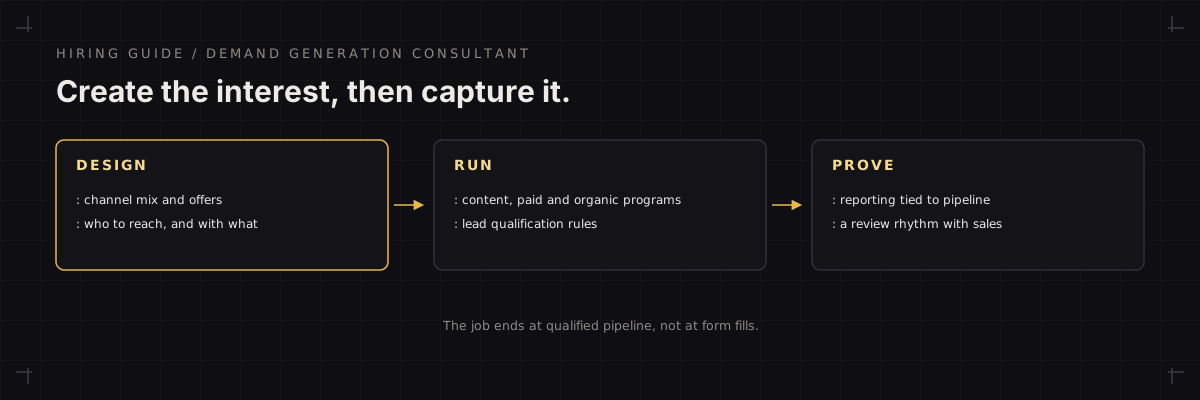
Short answer: a demand generation consultant designs and runs the system that creates and captures qualified interest for a B2B company: the channel mix, the offers, content and paid and organic programs, the rules for what counts as a qualified lead, and the reporting that ties it all to pipeline. They are accountable for qualified conversations reaching sales, not for traffic or form fills alone.
The title gets used loosely, so it helps to be specific about what the work covers and where it stops.
What the work usually includes
- Audience and offer. Deciding who the program is for and what is worth offering them, such as a guide, an audit, a benchmark or a consultation, so interest has something to attach to.
- Channel mix. Choosing where effort goes across search, content, paid media, email, community and outbound, based on where the audience already pays attention.
- Program build and run. Planning and operating the campaigns, with a rhythm for testing offers and cutting what does not work.
- Lead qualification. Writing down what makes a lead qualified, agreed with sales, so volume is not mistaken for progress.
- Reporting to pipeline. Connecting activity to qualified conversations and opportunities, not just clicks and downloads.
How it differs from nearby roles
| Role | Primary focus |
|---|---|
| Demand generation consultant | Qualified pipeline across channels |
| Growth marketer | Experiments across the funnel, often product-led |
| Lead generation agency | Volume of contacts, usually one channel |
| ABM consultant | Named target accounts, tightly coordinated with sales |
| Fractional CMO | Overall marketing leadership and planning |
If you are choosing between approaches, the guides on account-based marketing versus B2B lead generation and outbound versus inbound help frame it.
When to hire one
- Leads arrive, but sales says they are not qualified, or nobody agrees what qualified means.
- Marketing activity is spread across many channels with no clear reason for the mix.
- The founder or sales team still generates most pipeline personally.
- You have budget for programs but no one to design and run them.
What to ask before you hire
- How will we define a qualified lead, and who signs off on the definition?
- Which leading indicators will we review before revenue shows up?
- Who owns the accounts, data and creative if we part ways?
- How will you work with our sales team week to week?
Specific answers beat impressive-sounding frameworks. For the wider picture of what a B2B-focused consultant covers, read what a B2B SaaS marketing consultant actually does, and see the paid media and growth marketing services for how the programs are run.
FAQ
How is demand generation different from lead generation?
Lead generation focuses on capturing contact details from people already showing interest. Demand generation also covers creating that interest in the first place, through content, community and brand activity that works before a buyer is ready to fill in a form. A consultant usually covers both, and the split decides where the budget goes.
- Lead generation captures existing interest.
- Demand generation also builds interest before buyers are ready.
How long before a demand generation program shows pipeline?
It depends on sales-cycle length and the starting point, so be wary of fixed promises. Early signals such as qualified conversations, branded search and reply rates appear before closed revenue, and a good consultant agrees which leading indicators to review at 30, 60 and 90 days.
- Timing depends on sales-cycle length and starting point.
- Agree leading indicators to review at set checkpoints.