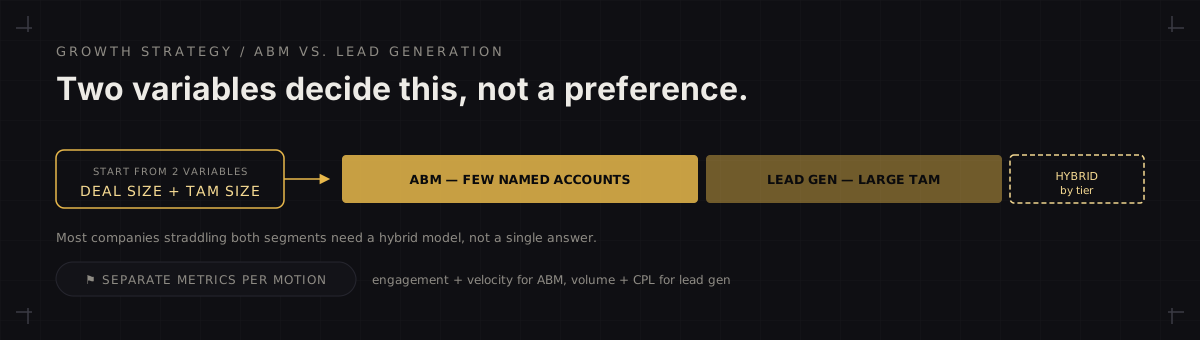
Short answer: Account based marketing fits a business with a short list of high-value named target accounts, large deal sizes, long sales cycles, and multiple stakeholders per deal. Traditional b2b lead generation fits a business with a large addressable market and a more self-serve or SMB-friendly sales motion, where reaching volume matters more than personalizing to individual named companies. Most companies straddling both segments need a hybrid model, not a single answer.
What account based marketing actually requires
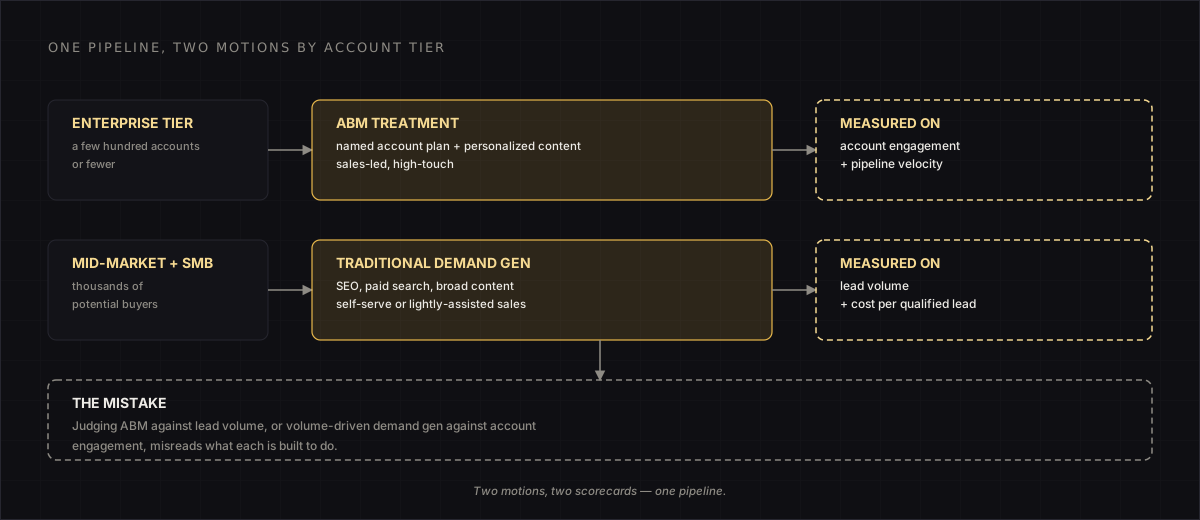
An account based marketing consultant starts every engagement the same way, by building a named list of target accounts, not a broad persona or industry segment. Every piece of content, every outreach sequence, and every ad campaign gets built around that specific list, sometimes down to the individual account level for the highest-value targets. This only makes economic sense when deal size is large enough to justify the personalization cost and the sales cycle is long enough, with enough stakeholders involved, that generic top-of-funnel content wouldn't move the deal forward anyway.
An abm strategist is judged on account engagement and pipeline velocity within that named list, not on total lead volume, which is a fundamentally different success metric than most demand generation teams are used to reporting against.
What traditional B2B lead generation actually requires
A b2b lead generation consultant running a traditional demand generation motion is optimizing for volume and cost per qualified lead across a much larger addressable market, where personalizing to every individual company isn't feasible or necessary. This model fits well when the buying process is simpler, fewer stakeholders, shorter cycle, lower average deal size, and a self-serve or lightly-assisted sales motion can convert a meaningful share of that volume without deep account-level customization.
A demand generation consultant working this model relies heavily on SEO, paid search, and broad content distribution to generate a consistent volume of inbound interest, then routes that volume through a scoring and qualification process rather than a hand-built account plan.
The decision framework: deal size and market size
| Factor | Favors ABM | Favors traditional lead generation |
|---|---|---|
| Average deal size | High, enterprise or upper mid-market | Lower, SMB or lower mid-market |
| Total addressable market | Small, a few hundred fit accounts or fewer | Large, thousands of potential buyers |
| Sales cycle | Long, multiple stakeholders | Shorter, fewer decision makers |
| Sales motion | High-touch, sales-led | Self-serve or lightly-assisted |
| Content approach | Personalized per account or tier | Broad, SEO and paid-driven |
Where hybrid approaches make sense
A company with a tiered customer base, a small number of enterprise logos alongside a much larger mid-market and SMB segment, usually benefits from running both models against different tiers rather than forcing one approach across the entire pipeline. The enterprise tier gets the named-account ABM treatment because the deal size justifies it, while the broader segment runs on a traditional demand generation motion built for volume. A b2b pipeline strategist managing this split needs separate reporting for each motion, since judging an ABM program against lead volume, or a volume-driven demand gen program against account-level engagement, misreads what each is actually built to do.
The mistake most companies make choosing between them
The most common error is picking ABM because it sounds more sophisticated, then applying it to a market that's actually large enough to need a volume-based approach. Building personalized account plans for a market of ten thousand potential buyers wastes the exact resource, precision and personalization, that makes ABM valuable in the first place. The reverse mistake is just as costly: running broad, unpersonalized lead generation against a market of forty named enterprise accounts, where every one of those forty deserves a level of attention a generic funnel will never deliver.
Bottom line
Neither model is inherently better, they're built for different market shapes. A short list of high-value named accounts with long, multi-stakeholder sales cycles calls for account based marketing. A large addressable market with a simpler sales motion calls for traditional lead generation, and a company straddling both usually needs a segmented, hybrid approach rather than a single answer applied everywhere. Getting this framework right before allocating next quarter's budget saves months of misdirected effort.
FAQ
What's the simplest way to decide between ABM and traditional lead generation?
Look at average deal size and total addressable market size together. A small number of high-value named accounts with long sales cycles points toward account based marketing, while a large addressable market that can support a self-serve or SMB-friendly sales motion points toward traditional demand generation. Most companies in between benefit from running both against different segments of their pipeline rather than picking one exclusively.
- Average deal size and total addressable market size are the two variables that should drive this decision.
- A hybrid approach segmented by account tier is common and often outperforms picking one model exclusively.
Is account based marketing just a rebrand of enterprise sales?
No. ABM is a coordinated marketing and sales motion built around a specific, named list of target accounts, with content, outreach, and advertising personalized to each account rather than broadcast to a broad segment. Enterprise sales can happen without any of that coordination, and ABM can support mid-market deals too, the defining trait is the named-account targeting, not the deal size alone.
- ABM is defined by named-account targeting and cross-functional coordination, not by deal size alone.
- Enterprise sales motions can exist without ABM, and ABM can apply below the enterprise tier too.