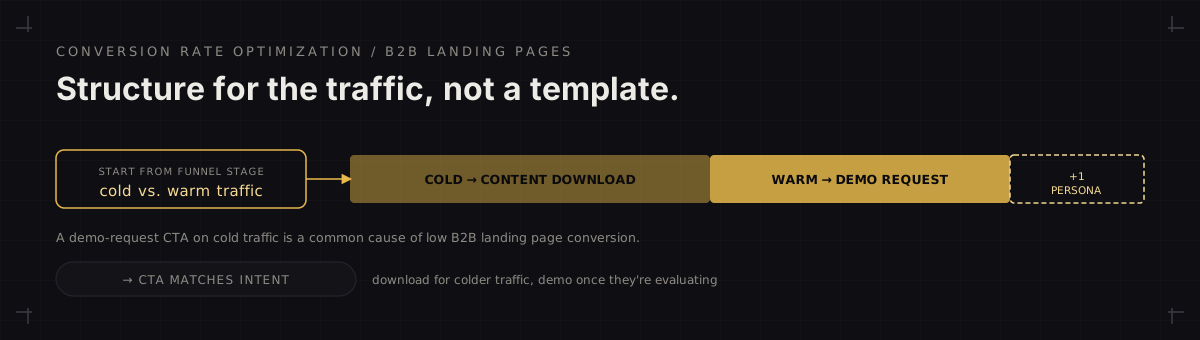
Short answer: Match the page to the traffic's funnel stage: cold traffic gets a content download with the form placed after value is established, while warm, high-intent traffic gets a demo or consultation request with the form above the fold. Using a demo-request CTA on cold traffic is a common cause of low B2B landing page conversion.
This is B2B-specific structure — for copywriting patterns that apply more broadly, see the high-converting landing page copy framework. B2B landing pages have distinct structural needs driven by longer, often multi-stakeholder buying decisions.
Form placement and length
Above-the-fold forms tend to suit high-intent traffic (a branded search, a direct referral); a longer page with the form appearing after value has been established suits colder traffic that needs more context first. Field count should scale with lead value — a high-ticket B2B offer can justify more qualifying fields than a low-commitment content download.
B2B-specific proof elements
- Client logos — particularly effective in B2B, where a prospect often looks for recognizable names in their own industry as a credibility signal.
- Specific case studies — a named (or anonymized, if required) result with real numbers outperforms a generic testimonial, especially for a considered B2B purchase.
- Analyst or press mentions — third-party validation carries particular weight in B2B decisions that often involve justifying a choice to others internally.
Demo request vs. content download: choosing the right CTA
Match the CTA to the funnel stage per the full-funnel campaign map: a content download suits earlier-stage, colder traffic not ready for a sales conversation; a demo or consultation request suits later-stage traffic that already understands the problem and is evaluating solutions. Using a demo-request CTA on cold, early-stage traffic is a common cause of low landing page conversion in B2B specifically.
Addressing multi-stakeholder buying
B2B pages often need to address more than one persona reading the same page — a technical evaluator and a budget-holder may both need to find their specific concern addressed, which sometimes justifies a distinct section or proof point speaking to each audience rather than a single generic pitch.
| Element | Cold Traffic | Warm/High-Intent Traffic |
|---|---|---|
| Form placement | After value is established | Above the fold |
| CTA type | Content download, low commitment | Demo/consultation request |
| Proof emphasis | Broad credibility (logos, press) | Specific, relevant case study |
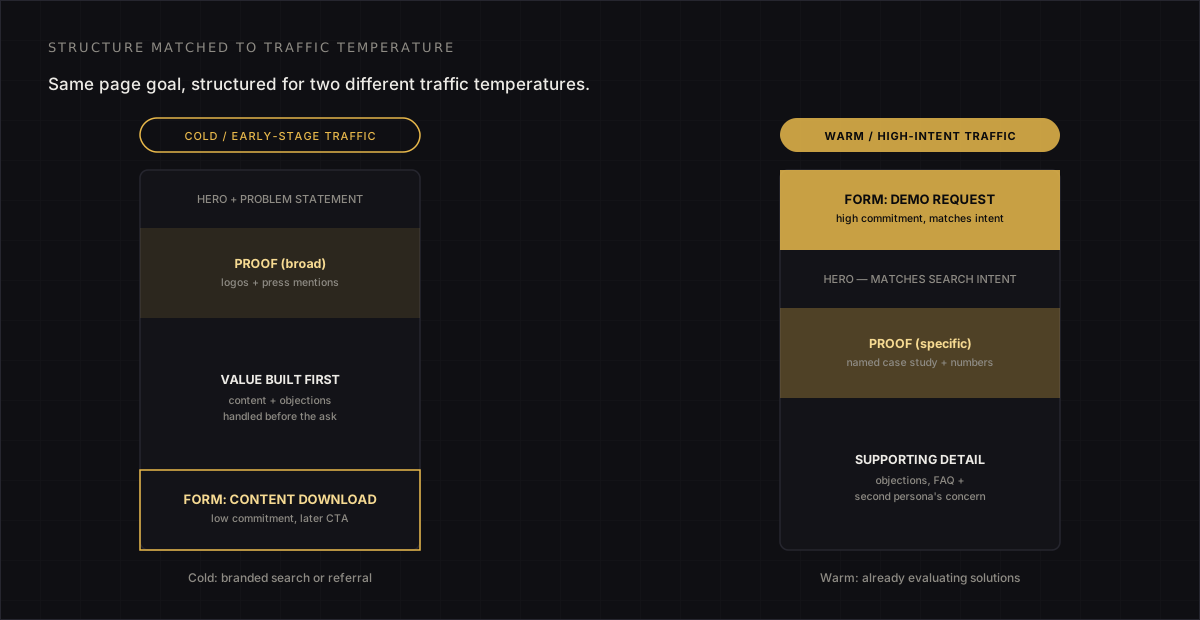
B2B landing page structure succeeds by matching form, CTA, and proof to both funnel stage and the reality of multi-stakeholder buying — the same discipline behind every Conversion Rate Optimization engagement I run for B2B clients.
FAQ
What makes a B2B lead generation landing page different from a general one?
B2B landing pages need to account for longer consideration cycles and multi-stakeholder buying decisions — favoring client logos, specific case studies, and analyst/press mentions as proof, matching the CTA (content download vs. demo request) to the visitor's actual funnel stage, and sometimes addressing more than one persona (a technical evaluator and a budget-holder) on the same page.
- B2B-specific proof (logos, case studies, third-party validation) carries particular weight given the considered nature of B2B purchases.
- Multi-stakeholder buying sometimes requires distinct sections speaking to different reader personas.
Should a B2B landing page ask for a demo or offer a content download?
Match the CTA to funnel stage — offer a content download for colder, earlier-stage traffic not yet ready for a sales conversation, and reserve a demo or consultation request for warmer, later-stage traffic that already understands the problem and is actively evaluating solutions; using a demo-request CTA on cold traffic is a common cause of low B2B landing page conversion.
- Mismatching CTA commitment level to traffic readiness is one of the most common and fixable B2B landing page mistakes.
- The right CTA choice depends on where the specific traffic source sits in the buyer journey, not a fixed rule.