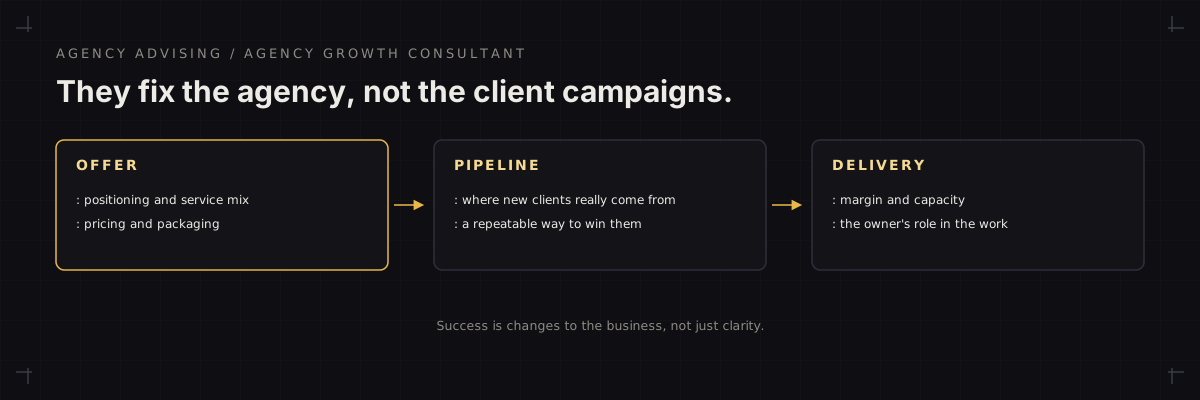
Short answer: an agency growth consultant is an outside advisor who helps agency owners fix the business of the agency itself: positioning, service mix, pricing and packaging, where new clients come from, delivery margin, and the owner's role. They do not run client campaigns. The point of hiring one is to change how the agency wins and delivers work.
Agencies often master client growth while neglecting their own. Referrals carry the pipeline, pricing was set years ago, and the owner is still the best salesperson and the final reviewer on every project. A growth consultant looks at those mechanics from the outside.
What they typically work on
- Positioning and service mix. Narrowing who the agency is for and what it is known for, so it competes on a clear promise instead of a long service list.
- Pricing and packaging. Moving from hourly or ad hoc quotes toward packaged offers and retainers that reflect value and protect margin.
- Pipeline. Identifying where good clients actually come from today and building a repeatable way to win more of them, beyond referrals alone.
- Delivery and margin. Looking at capacity, scope creep and utilization to see where profit leaks.
- The owner's role. Defining what the owner should stop doing, and what must be handed to a team or process.
Signs it is time
- New clients depend almost entirely on referrals and the owner's network.
- Revenue grows but profit does not.
- The owner is the bottleneck on sales, strategy and quality review.
- Prospects keep asking for discounts, or compare the agency purely on price.
- The agency cannot explain in one sentence why a client should pick it.
What they do not do
An agency growth consultant is not a white-label delivery partner and does not execute client work. If what you need is extra capacity for client deliverables, see the guide to white-label marketing consultants for agencies. It is also different from coaching, and from the work of choosing between an agency, freelancer and consultant as a client.
How to evaluate one
- Ask what they would want to see first. A good consultant starts with your numbers: revenue by client, margins by service and source of each client.
- Ask for the format and end point. A defined diagnostic with a written plan is easier to judge than open-ended advice.
- Check that they have worked with agencies of your size and kind.
- Be wary of promises about specific growth, and read how to evaluate marketing agency ROI claims, which applies equally to advisors.
If the agency needs its own marketing owner
Once the diagnosis is done, many agencies realize nobody owns their own marketing. A fractional CMO can take that on, running the agency's positioning, content and pipeline programs on an ongoing basis. The growth marketing service covers the programs themselves.
FAQ
How is an agency growth consultant different from a business coach?
A coach works mainly on the owner's mindset and habits. An agency growth consultant works on the agency's commercial mechanics: offer, pricing, pipeline sources and delivery margin, drawing on agency-specific experience. There is overlap, but you should leave with changes to the business, not only clarity.
- Coaches focus on the owner; consultants on the agency's commercial mechanics.
- Expect concrete changes to offer, pricing or pipeline.
Should an agency owner hire a consultant or a fractional CMO?
A consultant fits a defined diagnosis and plan over a few weeks. A fractional CMO fits when the agency needs someone to own its own marketing and pipeline on an ongoing basis. Many owners start with the first and move to the second.
- Consultant for a diagnosis and plan.
- Fractional CMO for ongoing ownership of the agency's own marketing.