Short answer: An affiliate or channel partner program avoids cannibalizing direct sales when commission structures are built around audience segments the direct team can't reach, incrementality is actually measured against a control group, and partners are recruited for genuine audience overlap with the target buyer, not just willingness to sign up.
1. The commission structure problem: paying twice for the same sale
The most common structural mistake an affiliate program consultant sees is a flat commission rate applied to every conversion regardless of where that lead actually came from. If a prospect was already in the direct sales pipeline, already on a demo call, or already searching the company's branded terms, and an affiliate link happens to touch that journey somewhere near the end, the business ends up paying a commission on a sale the direct team was going to close anyway. This is the single biggest reason partner programs quietly erode margin without anyone noticing for months, because the top-line revenue number still looks fine even as effective sales cost climbs.
2. Why incrementality tracking is the part everyone skips
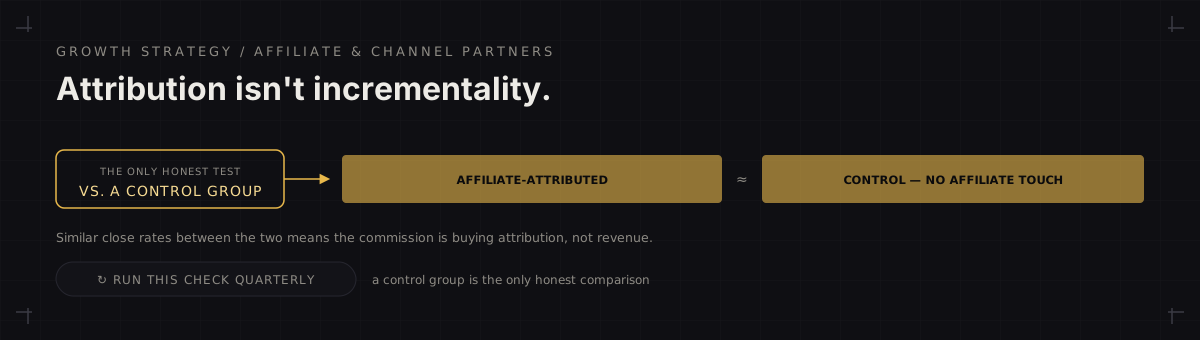
Most programs track clicks, signups, and attributed revenue, but almost none track whether that revenue is actually incremental, meaning whether it would not have happened without the affiliate's involvement. A partner marketing consultant sets this up by holding out a control segment, tracking direct and organic conversion rates for a comparable audience with no affiliate touchpoint, and comparing the two. If affiliate-attributed deals close at roughly the same rate as the control group, the commission is buying attribution, not incremental revenue. This single check, run quarterly, catches more program-level waste than any amount of tightening individual partner terms.
3. Recruiting partners for audience overlap, not just enthusiasm
A referral marketing strategist vets prospective partners on one question before anything else: does this partner's audience actually overlap with our ideal customer, and is that audience currently underserved by our existing channels? A partner with a large but generic audience, or one whose audience already finds the business through paid search or direct outreach, adds redundant reach at best and, at worst, actively competes with the internal sales motion for the same buyer's attention. The partners worth recruiting are the ones with real access, a niche community, a trusted advisory relationship, a distribution channel the business has no other way into.
4. Structuring tiers so commission scales with incrementality, not volume
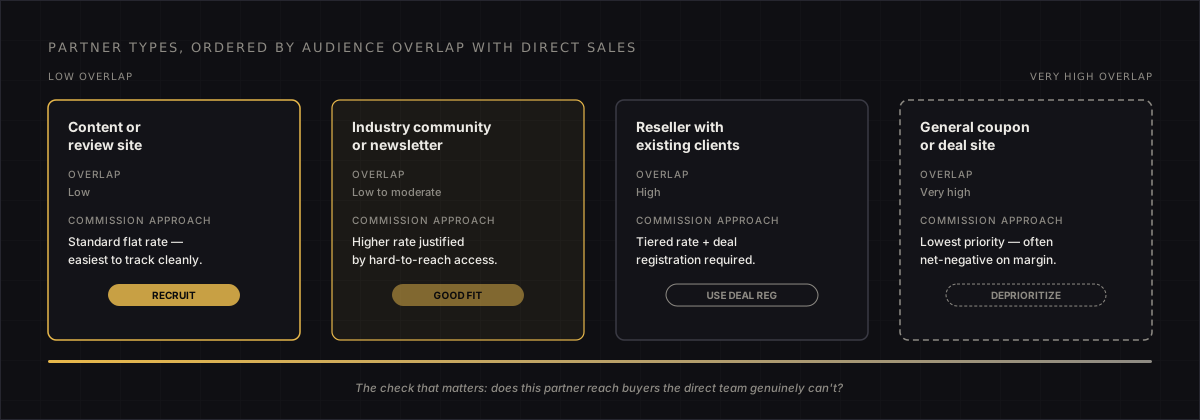
| Partner type | Audience overlap with direct sales | Recommended commission approach |
|---|---|---|
| Content or review site | Low, reaches early-stage researchers | Standard flat rate, easiest to track cleanly |
| Industry community or newsletter | Low to moderate, niche but relevant audience | Higher rate justified by hard-to-reach access |
| Reseller with existing client base | High, overlaps with outbound sales targets | Tiered rate with deal registration to avoid conflict |
| General coupon or deal site | Very high, mostly bottom-funnel intent | Lowest priority, often net-negative on margin |
A channel partner consultant typically recommends deal registration for the highest-overlap partner types, where a partner claims a specific account before working it, which prevents both the partner and the direct sales team from independently chasing the same prospect and creates a clean, auditable record of who actually sourced the deal.
5. Managing the program so it stays healthy after launch
Programs that work well at launch tend to decay the same way: new partners get recruited faster than underperforming ones get pruned, commission terms get grandfathered in past the point they're still justified, and nobody revisits the incrementality analysis after the first quarter. A working cadence is a quarterly review of every partner's actual incremental contribution, not just their tracked revenue, paired with a clear, published policy on what happens when a partner's audience starts to overlap more with the direct pipeline over time. This kind of ongoing management overlaps closely with broader growth marketing work, since partner revenue only means something in the context of total acquisition cost across every channel, not evaluated in isolation.
6. Where affiliate programs intersect with email and retention
Partner-sourced customers often need a different onboarding and nurture sequence than direct-sourced ones, since they arrived with less direct sales contact and more third-party trust already established. Coordinating that handoff, so a partner-sourced lead doesn't fall into a generic sequence built for a completely different buying journey, is usually an email marketing workstream that gets overlooked until churn data reveals the gap months later.
Bottom line
A partner program adds real value when it reaches buyers the direct team genuinely can't, and it quietly destroys margin when it pays commission on sales that were coming in regardless. The fix isn't more partners or higher commissions, it's an honest incrementality check run against a real control group, paired with recruiting discipline that says no to partners whose audience just duplicates the pipeline that already exists.
FAQ
How do you know if an affiliate program is cannibalizing direct sales?
Compare close rates and deal sizes on affiliate-attributed deals against a control group of prospects who never touched an affiliate link, using the same lead source and time period. If affiliate deals close at a similar rate to organic direct deals with the same profile, the program is likely just relabeling sales that would have happened anyway and collecting a commission for it.
- A control group of non-affiliate deals from the same source is the only honest comparison.
- Similar close rates between affiliate and organic deals is a sign of relabeling, not incrementality.
Should affiliate commissions ever be higher than the margin on a direct sale?
Only when the affiliate is reliably bringing in an audience the direct sales team has no independent access to, since that's the only scenario where the commission is buying something the business couldn't get on its own. If a partner's audience already overlaps heavily with the direct pipeline, a high commission just taxes revenue that was going to arrive regardless.
- Higher commissions are only justified by genuine audience access the direct team lacks.
- Overlapping audiences mean the commission is a tax on revenue that already existed.