The Pattern
B2B companies often run LinkedIn campaigns aimed at job titles, collect a steady flow of lead-form fills, and report a cost per lead that looks acceptable. Meanwhile sales says the leads are junior, off-target or not ready, and very few become opportunities.
What Teams Usually Try First
The usual response is to rework the creative, narrow the targeting again, switch between lead-gen forms and landing pages, or change the budget, all judged on click-through rate and cost per lead.
Where It Stalls
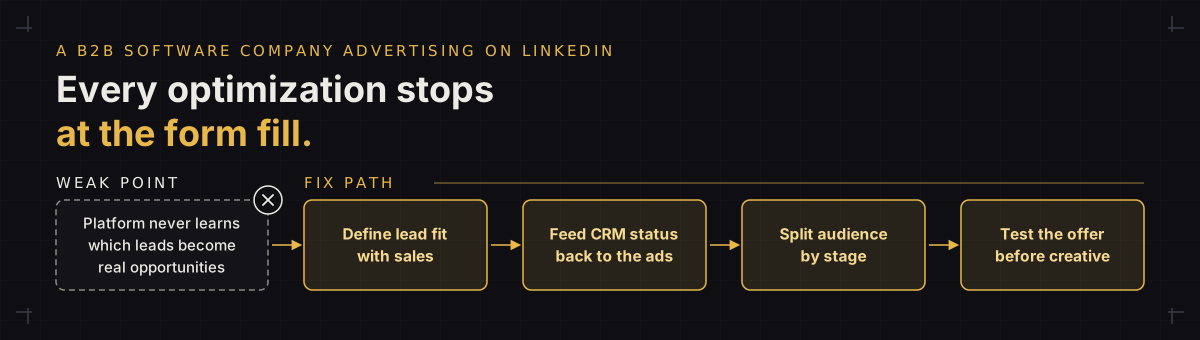
Every optimization stops at the form fill. The platform never learns which leads became real opportunities, so it keeps finding people who fill in forms cheaply, and the team has no shared definition of a qualified lead to judge campaigns against.
Recommended Approach
- Agree with sales on a fit-based definition of a qualified lead (company size, role seniority, use case) and tag every lead against it, so campaigns can be compared on quality and not just volume
- Carry lead status from the CRM back to the campaign level, and send opportunity-stage conversions back to the ad platform where it supports offline conversion imports, so optimization follows pipeline instead of form fills
- Split the audience by stage: cold audiences get a useful asset (a benchmark, a teardown, a checklist), and people who engaged with it are retargeted with a consultation or demo offer
- Test the offer before the creative, since a different offer changes who responds far more than a new headline does, and compare offers on qualified-lead rate and not on cost per lead
- Judge the programme on cost per qualified opportunity over a window long enough for the sales cycle, and review it on a fixed monthly cadence instead of reacting to week-to-week swings
What It Aims to Achieve
Aims to move budget toward the audiences and offers that produce sales conversations, and to replace cost per lead with cost per qualified opportunity as the number the campaign is run against.