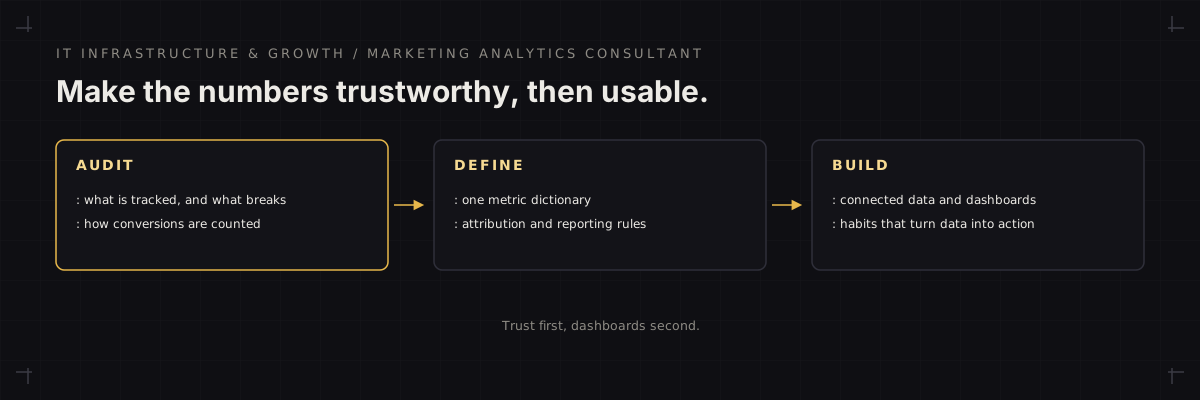
Short answer: a marketing analytics consultant makes marketing data trustworthy and usable. They audit what is tracked, agree one set of metric definitions and attribution rules, connect the data sources, build the reporting, and help the team use it to make decisions. The goal is a team that believes its numbers and knows what to do about them.
It is easy to confuse the role with neighbouring ones. A GA4 specialist configures one tool, a data scientist builds models, and a dashboard developer builds charts. A marketing analytics consultant sits across these, starting from the decisions the business needs to make.
What the work covers
- Tracking audit. Checking what is measured, what is missing, what double counts, and where consent or tag problems distort results.
- Metric definitions. Writing down what a lead, a qualified lead, a customer and a conversion each mean, so every report uses the same terms.
- Attribution rules. Agreeing how credit is assigned for decisions that matter, and being honest about what attribution can and cannot show.
- Data connections. Bringing ad platforms, analytics, CRM and revenue data together so they can be compared.
- Reporting and habits. Building dashboards that answer real questions, plus a regular review rhythm so the numbers lead to action.
Typical deliverables
| Deliverable | What it gives you |
|---|---|
| Tracking plan | A maintained list of events, owners and tests |
| Metric dictionary | One definition per metric, signed off by marketing and sales |
| Source reconciliation | Expected gaps between platforms, explained |
| Dashboards | Reports tied to decisions, not vanity numbers |
| Review rhythm | A weekly or monthly routine for acting on the data |
How it differs from nearby roles
A GA4 consultant focuses on one analytics tool. A marketing analytics consultant covers the wider set of sources and the agreement on what to measure. If the main difficulty is deciding how credit is shared between channels, the guide to marketing attribution models frames the choices.
When to hire one
- Platforms report different results for the same period and nobody can explain the gap.
- Dashboards exist but people no longer trust or use them. The audit on untrusted marketing dashboards describes the usual causes.
- Tracking broke during a redesign or migration and was never fully repaired.
- Spend decisions are being made on numbers the team does not believe.
What to expect early
In the first weeks, expect questions before outputs: which decisions the data should support, who uses which report, and what has changed recently. A good consultant will test conversions end to end before touching a dashboard, then deliver the tracking plan and definitions, then the reporting. Use the conversion tracking validation checklist as a self-check, and see the marketing infrastructure service for how the work is delivered.
FAQ
What should a tracking plan contain?
The business questions it supports, plus each event or conversion with its name, trigger and properties, where it fires, who owns it and how it is tested. A short plan that is maintained beats a large one that is out of date.
- Questions first, then events, owners and tests.
- A maintained short plan beats a stale long one.
How do I know the numbers can be trusted afterward?
Ask for validation: test conversions traced from click to CRM record, a reconciliation between platforms with the expected gap explained, and monitoring that alerts when tracking breaks. Trust comes from checks that keep running, not from a one-off cleanup.
- Traced test conversions and reconciliation are the evidence.
- Ongoing monitoring keeps the numbers trustworthy.