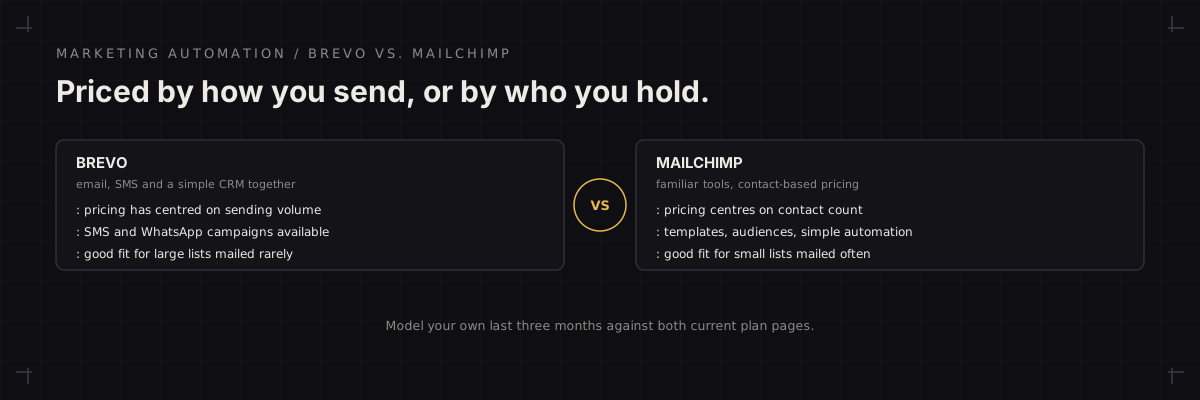
Short answer: Brevo tends to suit small businesses that email a large list but not very often, and want email, SMS and a simple CRM in one tool with pricing tied to sending volume. Mailchimp tends to suit teams that value its templates, audience tools and familiarity, and accept pricing that follows contact count. Check both vendors' current plans before deciding, because both change them often.
For most small businesses the platform matters less than the habits around it: a clean list, a welcome sequence that sends, and a regular rhythm of useful campaigns. But the cost and feature differences are real, so it is worth comparing on your own numbers.
Where Brevo tends to fit
- Large list, light sending. Brevo has historically priced around how many emails you send rather than how many contacts you hold, which can favor lists that are big but mailed occasionally.
- More than email in one place. SMS and WhatsApp campaigns and a simple CRM sit alongside email, which suits a business that wants one tool for several touchpoints.
- Transactional email. It handles order and account messages alongside marketing sends, which small online shops often need.
Where Mailchimp tends to fit
- Familiar tools. Its template library, audience management and campaign builder are widely known, which makes hiring help or handing over work easier.
- Small lists mailed often. Contact-based pricing can work out well for a compact, engaged list with frequent campaigns.
- Broad integrations. A long list of connected apps and ecommerce platforms covers most small-business stacks.
Compare on your own numbers
| Input | Where to find it |
|---|---|
| Total contacts, including inactive | Your current platform's audience page |
| Sends per month, last three months | Campaign and automation reports |
| Channels you actually use | Email only, or email plus SMS or WhatsApp |
| Automations you need | Welcome, cart, re-engagement sequences |
Run those inputs through each vendor's current pricing page rather than relying on a general rule, and include the cost of cleaning inactive contacts, which changes the result for contact-based plans.
Before you switch
Moving platforms is mostly rebuild work. Clean the list first with the pre-campaign list cleaning guide, recreate the basics from the welcome email sequence framework, and warm up sending volume in stages so inbox placement does not drop. If you sell online and want data-driven flows, the better comparison may be Klaviyo vs. Mailchimp for D2C brands. The email marketing service covers setup and migration end to end.
FAQ
Which is cheaper for a small business?
It depends on the shape of your sending, not the brand. A large list that is mailed rarely tends to favor volume-based pricing, and a small list mailed often tends to favor contact-based pricing. Model your own list size and send counts for the last three months against both current plan pages, since both vendors change plans often.
- List size and send frequency decide the cheaper option.
- Check both current plan pages, because plans change.
Is migrating from Mailchimp to Brevo painful?
The list export is the easy part. The work is rebuilding automations and templates, re-checking sender authentication, and warming up volume gradually, so plan a staged cutover rather than a same-day switch.
- Rebuilding automations and templates is most of the effort.
- Warm up sending volume in stages after the move.