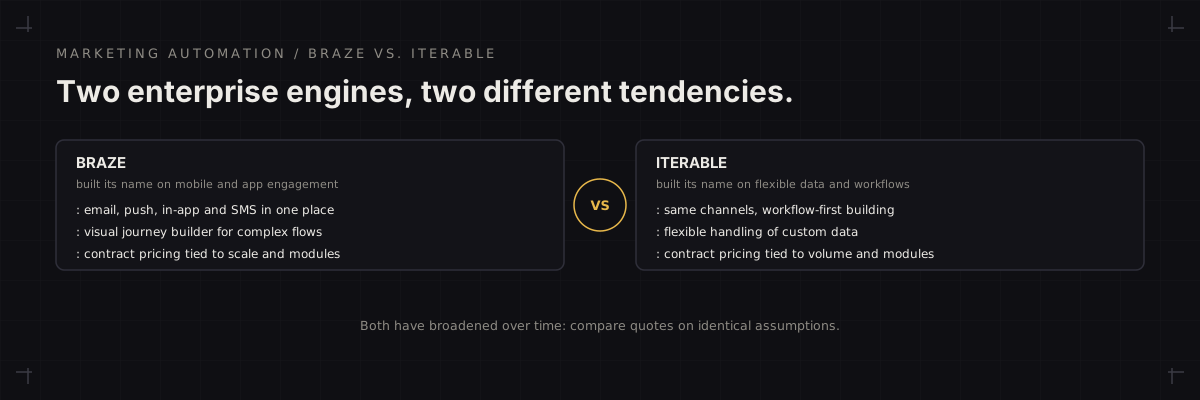
Short answer: Braze tends to suit larger consumer and mobile-first brands that need high-volume, cross-channel messaging with a visual journey builder, while Iterable tends to suit teams that want flexible data handling and workflow building across the same channels. Both are contract-priced enterprise platforms, and neither is the right size for a team that sends a weekly newsletter.
Braze and Iterable both orchestrate lifecycle messaging across email, push, in-app messages and SMS, driven by user events and attributes. The differences are tendencies, not rules, because both vendors have broadened their products over the years. Treat what follows as a starting point for a demo, not a verdict.
Where Braze tends to fit
- Mobile and app-heavy products. Braze built its reputation on engagement for apps, so push and in-app messaging are central rather than add-ons.
- Complex, multi-step journeys. Its visual journey builder suits teams mapping many branches, delays and channel switches in one canvas.
- Scale and data streaming. Larger teams often value the way event and engagement data can be streamed onward to a warehouse or other tools.
Where Iterable tends to fit
- Flexible handling of custom data. Teams that bring varied data into messages (catalogs, product events, custom objects) often cite this as the draw.
- Workflow-first building. Marketers who think in triggers, branches and audiences can assemble programs without heavy engineering after the integration.
- Cross-channel parity. It covers the same core channels, so the decision often comes down to how each handles your specific data model.
The questions that actually decide it
| Question | Why it matters |
|---|---|
| Which channels carry the most volume? | App-first push and in-app favors one profile, email-led programs another |
| How varied is your data model? | Custom objects and catalogs need testing in a real demo |
| Who builds programs day to day? | Marketers, lifecycle specialists or engineers |
| What will contract volume look like? | Quotes diverge once modules and volume are fixed |
Run the evaluation on your own data
Ask each vendor to rebuild one real journey, such as your onboarding series, using a sample of your own events. The way each handles your data in that exercise tells you more than any feature grid.
When neither is the right size
If your list and message volume are modest, a platform built for enterprise contracts will cost more in money and attention than it returns. Teams earlier in their journey are usually better served by Customer.io or Klaviyo, or a CRM-led setup from the marketing automation service. The marketing automation workflows for SaaS guide shows which programs to build first on any of these tools.
FAQ
Are Braze and Iterable priced publicly?
Both are generally sold on custom, contract-based pricing tied to volume and the modules you need, so the real number comes from a sales conversation. Compare quotes on identical assumptions (monthly active users, message volume, channels, data features), because a headline per-message figure hides add-ons.
- Pricing is usually custom and contract-based.
- Compare quotes on identical volume and feature assumptions.
What does implementation really take?
Integrating the SDK or API, defining the event and attribute schema, building a handful of core journeys, and migrating templates and audiences. The schema decisions take longer than the tooling, and teams that rush them end up rebuilding segments later.
- Schema design takes longer than the technical integration.
- Rushed schemas lead to rebuilt segments later.