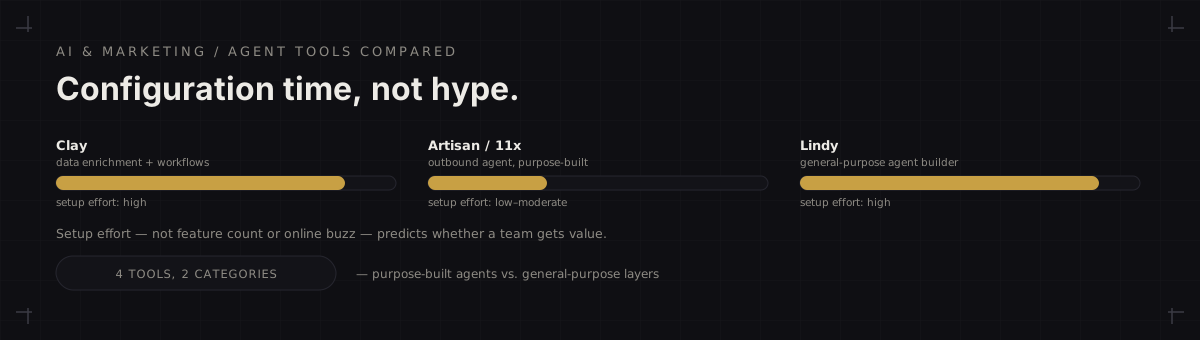
Short answer: Artisan and 11x are purpose-built outbound agents with low to moderate setup effort, Clay is a flexible data enrichment and workflow builder that requires someone to build and maintain it, and Lindy is a general-purpose agent builder with high setup effort across functions. Pick based on how much configuration time your team will actually invest, not on which tool is loudest online.
AI agent tools for marketing and sales have split into two rough categories, purpose-built outbound agents that run a specific job end to end, and general-purpose data or automation layers that a team configures for many jobs. Clay, Artisan, 11x, and Lindy each sit in a different spot on that spectrum.
Clay: data enrichment as the core job
- Best at: pulling and combining data from dozens of sources into one enriched record, then using AI steps to qualify, score, or draft messaging off that combined data.
- Flexibility. Highly configurable, closer to a programmable workflow builder than a fixed product, which means real setup time but very little ceiling on what it can be made to do.
- Best fit: teams with someone willing to build and maintain workflows, who want enrichment and research automated without buying a fixed, opinionated outbound product.
Artisan and 11x: purpose-built AI outbound agents
- Best at: running a defined outbound motion, research, personalized first-touch messaging, and follow-up sequencing, with far less configuration than Clay requires.
- Trade-off. Less flexible than a general-purpose tool, since the workflow is largely fixed to what the product was built to do.
- Best fit: teams that want outbound volume increased quickly without building custom workflows, and are comfortable with a more templated approach to messaging.
Lindy: general-purpose agent building
- Best at: building custom AI agents for a range of internal workflows beyond just outbound, meeting scheduling, inbox triage, lead qualification, and other repetitive tasks defined by the team.
- Trade-off. Because it's general-purpose, getting a specific marketing workflow production-ready still takes real configuration, similar to Clay.
- Best fit: teams wanting one agent-building tool across multiple functions rather than a separate point tool for each job.
Choosing based on team setup, not hype
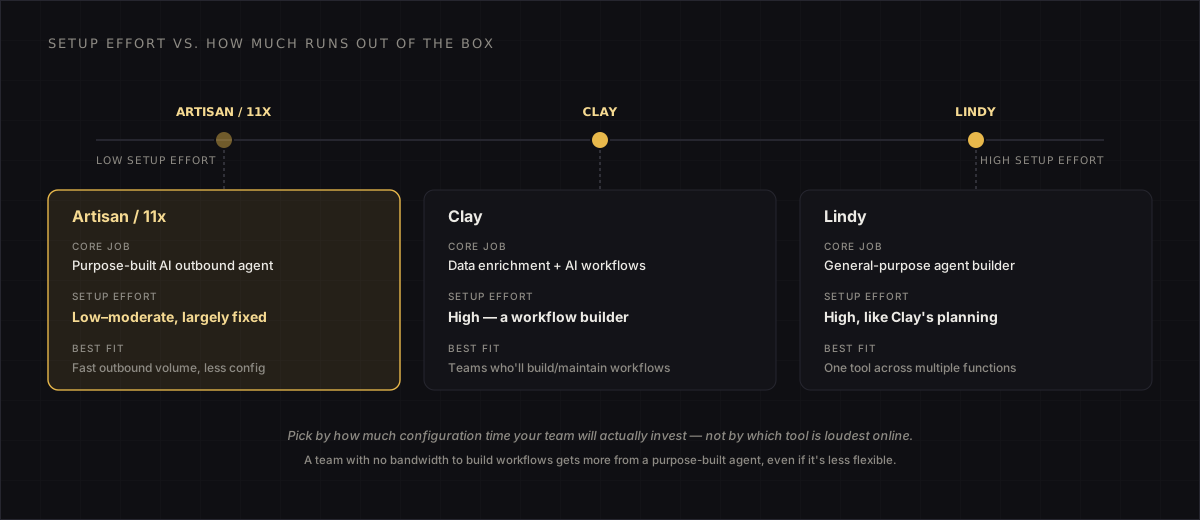
| Tool | Core Job | Setup Effort | Best Fit |
|---|---|---|---|
| Clay | Data enrichment and workflows | High | Teams that will build and maintain workflows |
| Artisan / 11x | AI outbound agent | Low to moderate | Teams wanting fast outbound volume |
| Lindy | General-purpose agent builder | High | Teams wanting one tool across functions |
The mistake most teams make is picking based on which tool is loudest online rather than how much configuration time they're actually willing to invest. A team with no bandwidth to build workflows gets more from a purpose-built outbound agent even if it's less flexible, while a team with an operator who enjoys building automations gets far more long-term value from Clay or Lindy's flexibility.
FAQ
Are AI SDR tools like Artisan and 11x actually replacing human SDRs?
They're replacing a portion of the repetitive research and first-touch outreach work SDRs do, not the full role. Teams using these tools successfully tend to keep a human reviewing messaging quality and handling replies that require judgment, while the AI agent handles volume research and initial sequencing. Fully unattended outbound at scale still produces enough messaging misses to need a human in the loop for quality control.
- These tools handle volume research and first-touch outreach, not the full SDR role.
- Successful setups keep a human reviewing quality and handling nuanced replies.
Is Clay a replacement for a CRM or CDP?
No. Clay is a data enrichment and workflow layer that pulls from many data sources and can trigger AI-driven actions, but it isn't a system of record for customer relationships or a warehouse-native event store. Most teams run Clay alongside a CRM and CDP, using it to enrich and route data into those systems rather than to replace them.
- Clay is an enrichment and workflow layer, not a system of record.
- It typically runs alongside a CRM and CDP, feeding data into them.